Esports Platform

Dreamteam

Infrastructure platform for esports — player analytics and performance tracking across CS:GO, Apex Legends and more, for 1.2M+ users worldwide.
Role

Senior Product Designer

Timeline

~15 Months

Industry

Esports · Gaming Analytics

Scope

Product, Web, System

Description

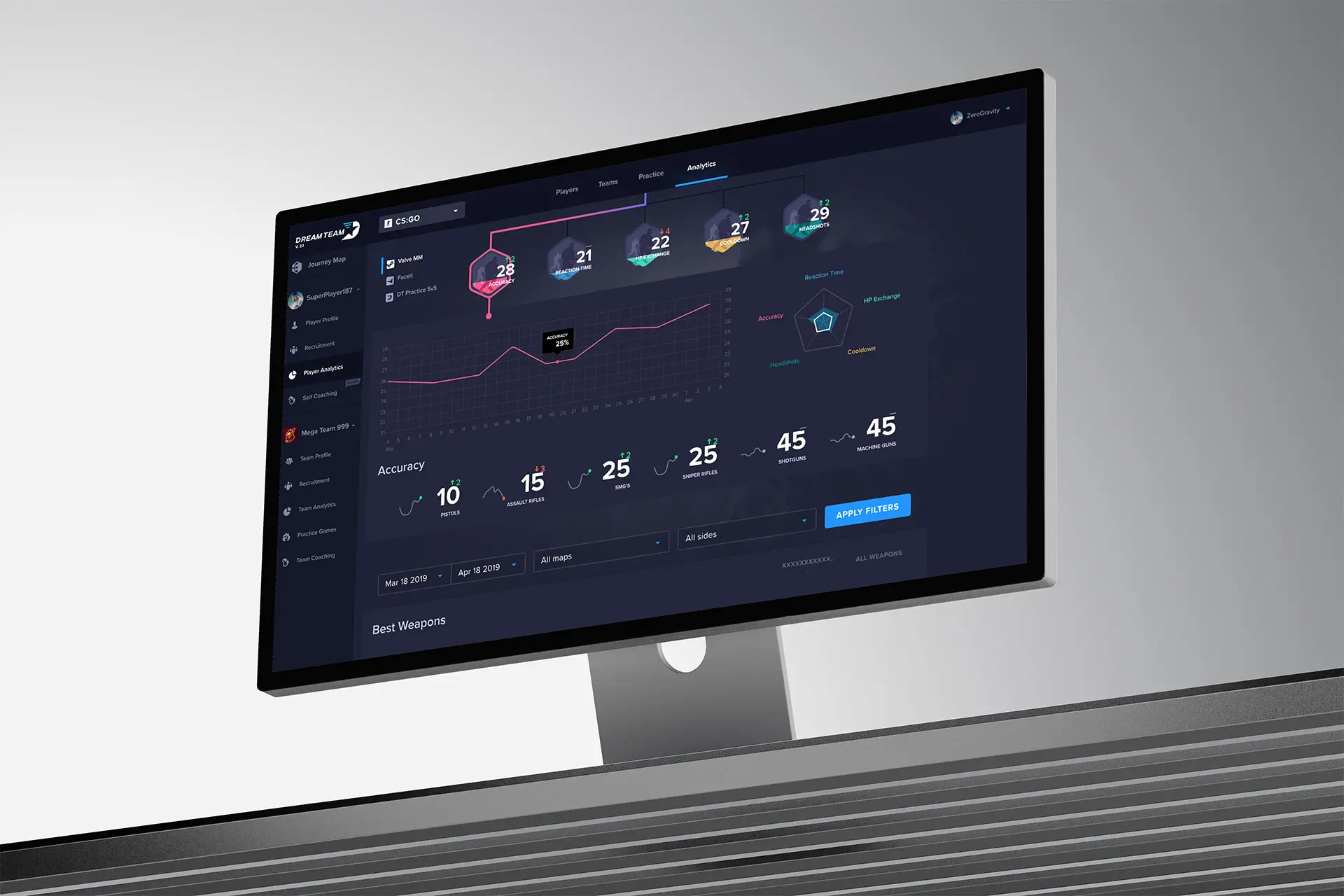
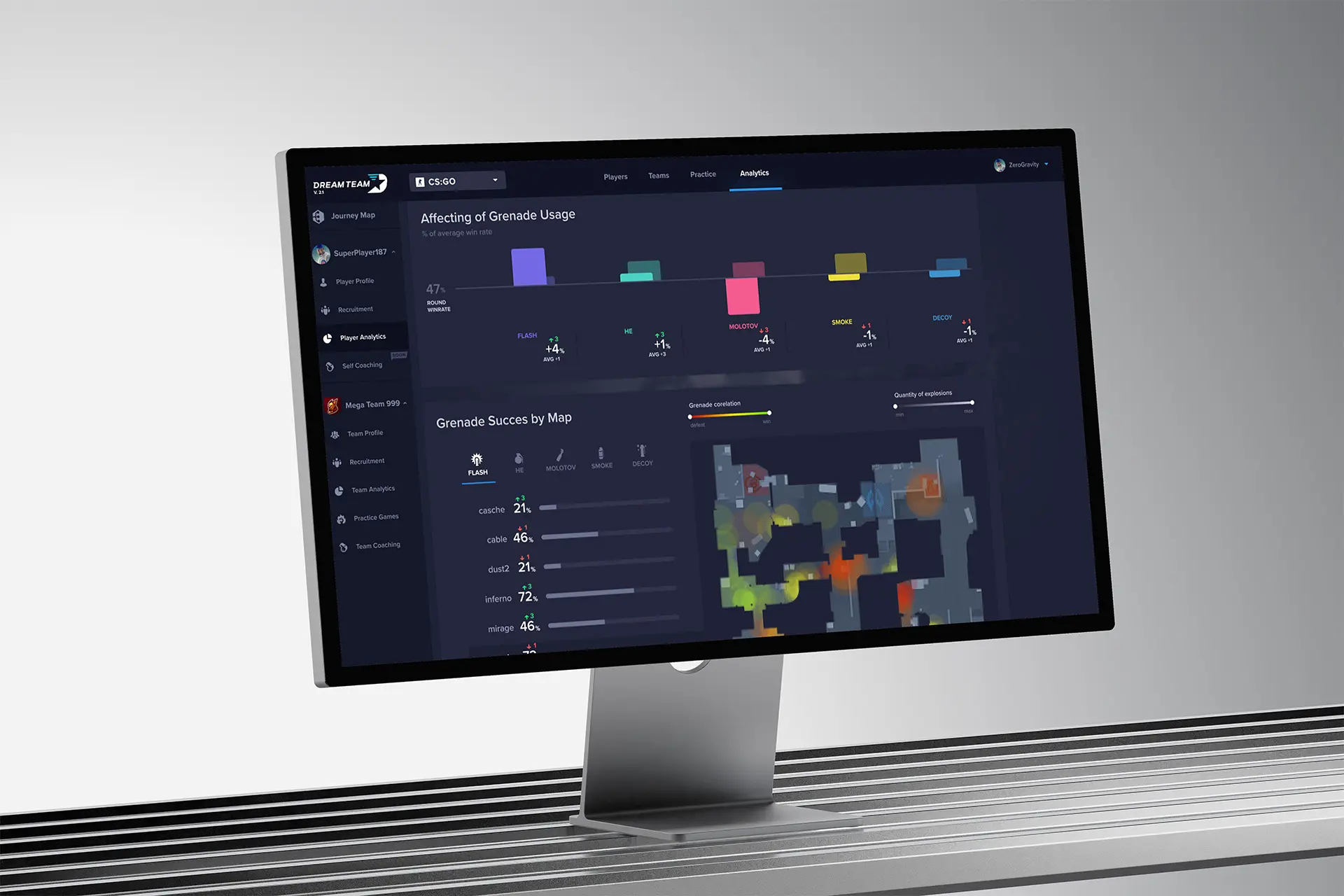
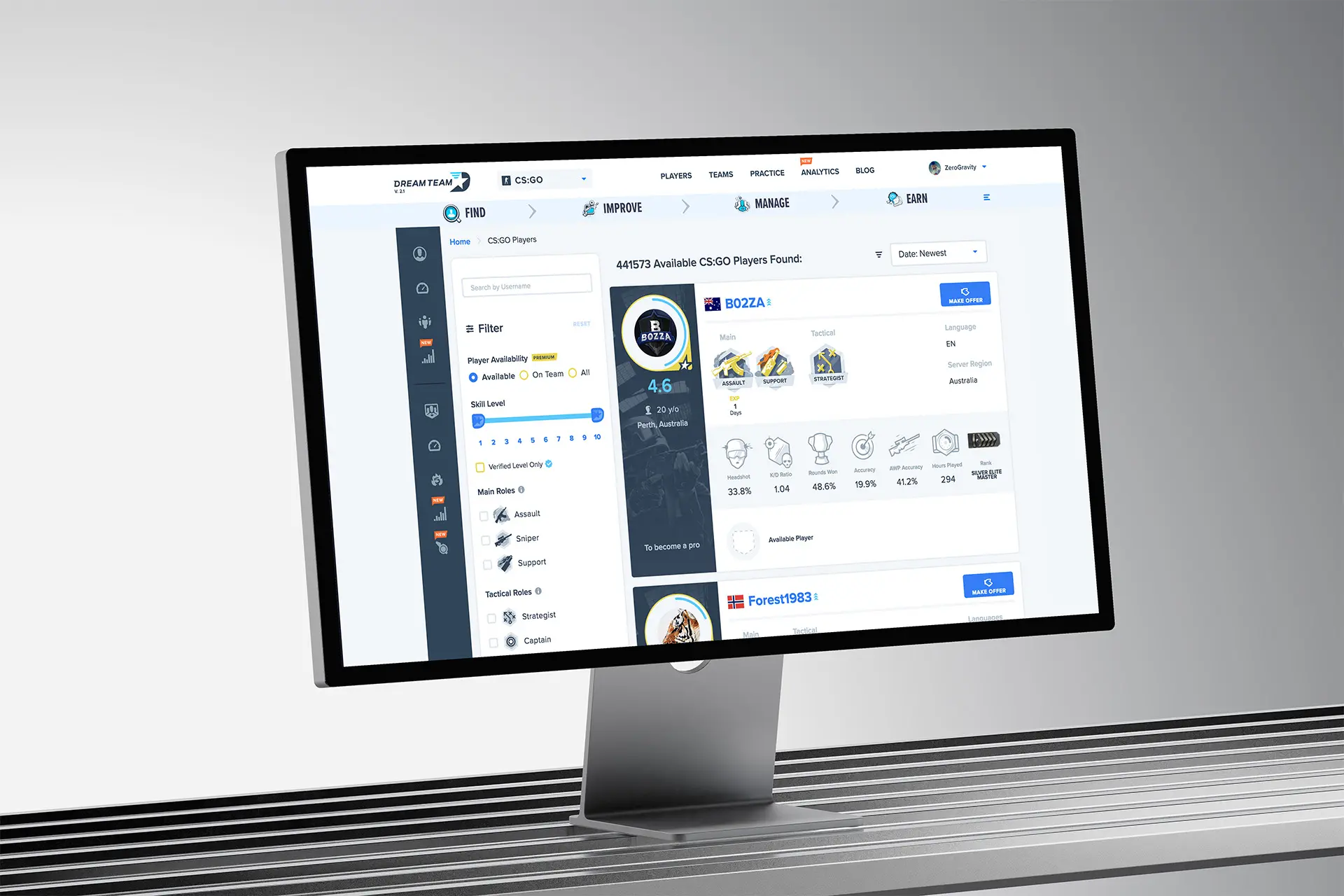
DreamTeam — the largest esports recruitment platform, 1.2M+ users, partnered with Fnatic, NAVI, Faceit, and ESL. The analytics platform turns complex in-game performance data into clear, actionable insight for players, teams, and coaches across multiple titles.

Sr. UX Designer (Oct 2018 – Dec 2019). Worked from early business requirements to a validated product vision with PMs and engineers, grounded in UX heuristics and live research.

Scope of Work

Background Line

The problem

Players didn't lack data. They lacked a direction.
Esports tooling drowned players in numbers — K/D, ADR, win rates across titles — without telling anyone what to do with them. The same data had to serve a solo player, a team, and a coach, each with a different job-to-be-done.
Players
Treated analytics as a post-match scoreboard: they looked once, felt judged, and left. Weekly return was low.
Coaches
Gave sharp feedback that lived in Discord and docs, disconnected from the gameplay it referred to — so most of it was never acted on.
One model, three jobs
One data model was stretched across three audiences, so nobody's view felt built for them.

Research & Discovery

Chasing direction, not more stats
01
What we assumed
Players wanted more stats and deeper filters — give them richer dashboards and engagement would follow.
02
What we investigated
Live interviews and research with players, teams, and coaches across CS:GO and Apex, plus task tests: show a real post-match breakdown and ask 'what would you change next game?'
03
What we found
Players didn't study dashboards. They wanted a verdict — 'am I improving, and what do I fix next?' — and the raw numbers couldn't answer that.
04
What surprised us
The highest-ranked players used the stats least — they already knew their next move. Mid-tier players, the bulk of the base, wanted direction the product never gave them.

The insight that changed everything

“Players measure themselves in ranks and goals, not metrics. So the product wasn't analytics — it was progress: turning scattered data into a visible path with a clear next step.”
Scattered stats
A visible path
Your next move

Design principles

Three rules, each traceable to one insight
01
Lead with the next action
Not the scoreboard — the numbers sit underneath as proof.
02
One system, three lenses
The same data reframed for player, team, and coach, never one view bolted onto all three.
03
Make progress earnable and visible
Improvement should look like a path you climb, not a chart you read.

Strategic decisions

Three decisions that made the bet real
01
Skill Tree — progression vs. raw analytics
THE TENSION
A dense analytics view feels 'complete' but inert; a progression system is opinionated and risks oversimplifying real skill.
THE CALL
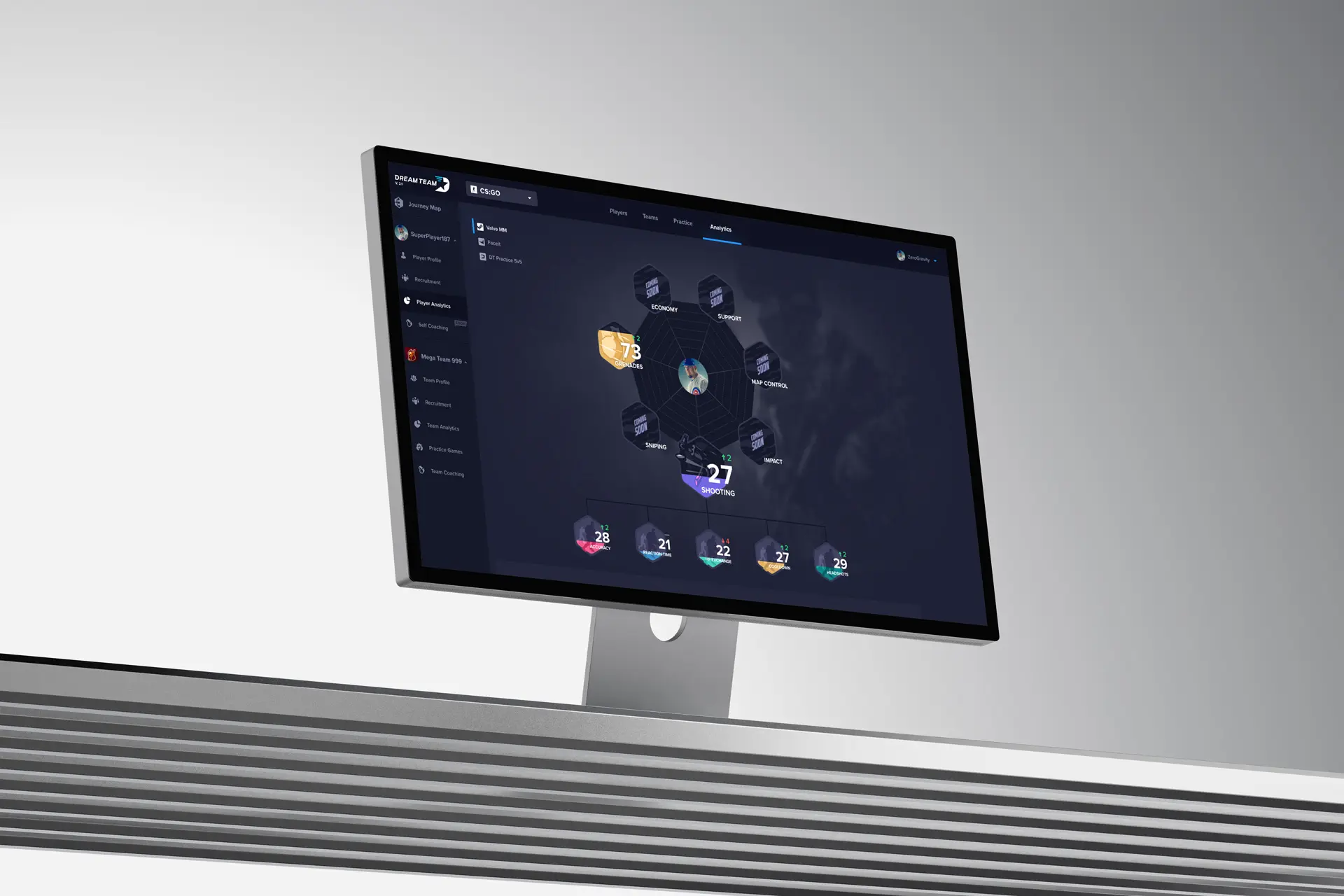
Built a visual Skill Tree so players track and develop skills across titles — a guided path over an exhaustive stat wall, with some advanced metrics moved to a secondary view.
THE RESULT
Players came back to work on a named skill rather than glance at a score; repeat engagement roughly doubled.
02
Coaching — feedback that gets applied
THE TENSION
Coaches' best advice lived outside the product, so follow-through was invisible and rare.
THE CALL
Built an end-to-end coaching experience where players receive, track, and apply feedback in one place, tied to the gameplay it referenced.
THE RESULT
Feedback stopped evaporating — applied coaching notes became a routine part of a player's week.
03
Premium — discovery without resentment
THE TENSION
Monetize without gating the value that earns trust — a paywall in the wrong place punishes the engaged players you want.
THE CALL
Designed premium discovery, upgrade flows, and access states so players felt the value before the paywall, with locked states that taught rather than blocked.
THE RESULT
Upgrades came from players who'd already hit the value, not from frustration — a higher-intent conversion path.

Solution Design

From scoreboard to path
The product reorganizes around progress — a Skill Tree, a coaching loop, and role-specific lenses — so one platform serves players, teams, and coaches coherently.
Coaching Platform
Receive, track, and apply coach feedback as one loop, not scattered notes.
Navigation & IA
A platform-wide architecture spanning player, team, and coaching surfaces.
Skill Tree
A visual progression system for tracking and developing in-game skills across titles.
Premium
Feature discovery, upgrade flows, and access states that surface value first.

Critical Moments

Where the work was actually decided
Vision through rapid testing
I worked from early requirements to a validated vision — rapidly creating and testing concepts with PMs and engineers, and using research footage to settle debates with evidence, not opinion.
Reframing around progress
When the team leaned toward a richer dashboard, I brought interview clips of players bouncing off the numbers and reframed the work around progress and the Skill Tree.
Cutting to protect the roadmap
I backed cutting a deeper team-analytics module that served a small power-user slice — it wasn't the engagement problem the platform needed to solve first.

Impact

Results
18% → 41%
Weekly return to analytics
After shifting from scoreboard to progress.
68%
Coach notes acted on
Up from roughly 1 in 5 before the loop.
+44%
Premium conversion
Driven by high-intent players who'd already hit the value.
1.2M+
Users on the platform
With partnerships across Fnatic, NAVI, Faceit, and ESL.
North-star: players who improved their rank — not players who viewed stats.

Reflection

What I'd carry forward
Bring coaches into discovery earlier
I designed the three lenses close together but validated the coach experience last; bringing coaches into discovery earlier would have caught loop friction sooner.
Treat 'what to fix next' as core
I'd treat the Skill Tree's recommendation logic as a core experience constraint from day one, not a layer added after the visuals — the recommendation quality is the product.
Esports already had the data. We gave players the path.

Let's Work
Together.

Have a project in mind? I'm always open to new ideas and collaborations. Let's talk.

Made in Warsaw with Love. All rights reserved.